
Industrial Construction Services in Gujarat
Civil work, flooring, painting, and modification — handled by one contractor, start to finish.
We Work as Your Industrial Civil Contractor, Start to Finish
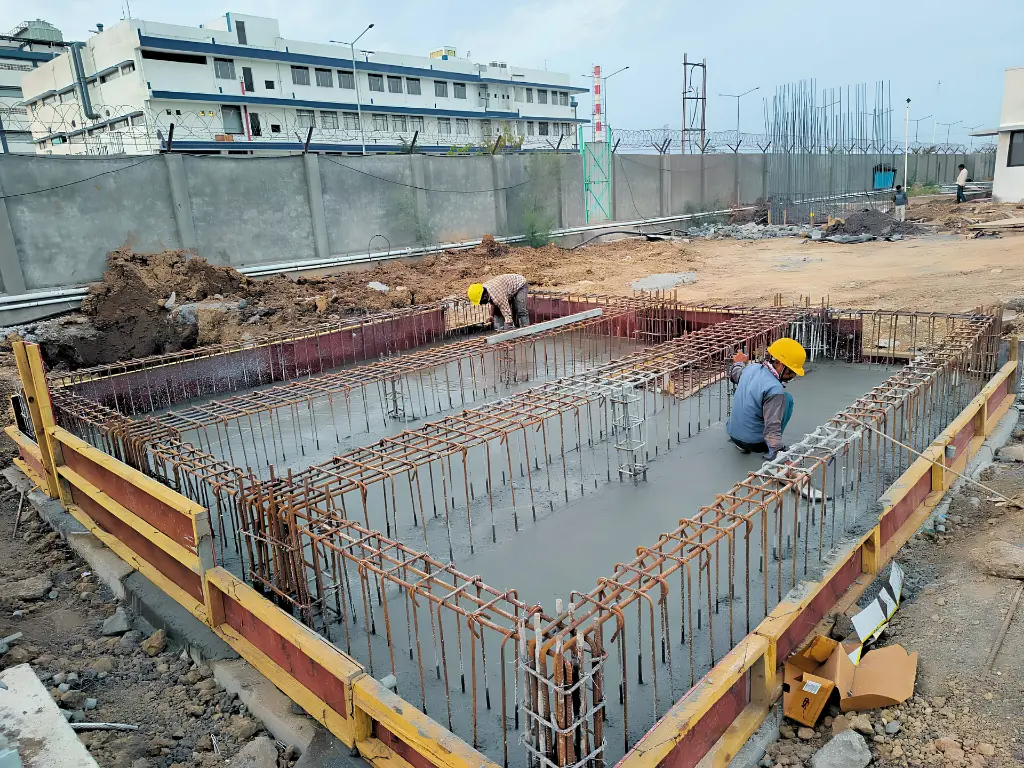
Industrial civil work covers the RCC structure of your plant – footings, columns, beams, slabs, MCC rooms, cooling towers, and control rooms. We handle it as your industrial civil contractor from the first excavation to final handover, built to carry heavy equipment and run for decades.
Most of our civil work happens inside plants that are already running. That means custom shuttering for tight spaces, careful sequencing around live equipment, and pours planned around your production schedule – not the other way around. We’ve built chemical containment bund walls, cleanroom base structures, overhead water storage tanks (ESR), and ETP civil works for effluent treatment plants.
- RCC Structures footings, columns, beams, slabs
- MCC Rooms & Cooling Towers - for live plant infrastructure
- Built Around Live Operations - sequenced around your production schedule
Can you build inside a plant that's still running?
Yes – most of our civil work happens exactly that way. We plan pours and shuttering around your production schedule, not the other way around.
Can you build inside a plant that's still running?
Yes – most of our civil work happens exactly that way. We plan pours and shuttering around your production schedule, not the other way around.
We're Your Industrial Flooring Contractor, From Sub-Base to Finish
Industrial flooring needs to survive heavy machinery, forklifts, and chemical spills – ordinary concrete doesn’t hold up. As your industrial flooring contractor, we lay VDF, Tremix, and epoxy systems built for exactly that kind of load, plus acid-resistant flooring for chemical and pharma areas, and repair work on existing damaged floors.
Every flooring job starts with the sub-base – get that wrong and the finished floor fails within a year, no matter how good the top coat is. We prepare the base properly, then apply the right system for your space: VDF or Tremix for warehouse and machine-load areas, epoxy for GMP-compliant production floors and cleanrooms where dust and chemical resistance matter most.
| Flooring Type | Best For | Key Property |
|---|---|---|
| VDF / Tremix | Heavy machinery load, warehouse floors | High compressive strength |
| Epoxy Flooring | Chemical/pharma clean environments | Chemical & stain resistant |
| Concrete Repair | Existing damaged industrial floors | Cost-effective restoration |
What's the difference between VDF and epoxy flooring?
VDF (Vacuum Dewatered Flooring) is a concrete-based system built for heavy machine and vehicle load. Epoxy is a resin coating, better suited for chemical resistance and clean, dust-free environments like pharma production floors.
What's the difference between VDF and epoxy flooring?
VDF (Vacuum Dewatered Flooring) is a concrete-based system built for heavy machine and vehicle load. Epoxy is a resin coating, better suited for chemical resistance and clean, dust-free environments like pharma production floors.

We're Your Industrial Painting Contractor for Corrosion & Chemical Protection
Industrial painting protects steel and concrete from rust, chemical exposure, and weather – without it, structures degrade fast in a plant environment. As your industrial painting contractor, we apply anti-corrosion coatings, epoxy and PU systems, and precision tank and pipeline painting built to handle harsh industrial conditions.
We don’t just paint – we protect. Structural steel painting extends the life of exposed metal frameworks in chemical environments. For safety compliance, we also handle floor and line marking to strict industrial standards, alongside tank and pipeline painting jobs that need precision, not just coverage. Epoxy and PU aren’t interchangeable — each is built for a different kind of exposure.
| Flooring Type | Best For | Key Property |
|---|---|---|
| Epoxy Coating | Tanks, pipelines, plant floors | Strong chemical resistance |
| PU Coating | Outdoor structures | UV & weather resistant, stays flexible |
| Anti-Corrosion Coating | Exposed structural steel | Long-term rust protection |
What's the difference between epoxy and PU coating?
Epoxy holds up best against chemical exposure — tanks, pipelines, plant floors. PU handles outdoor weather and UV exposure better, and stays flexible instead of cracking over time. We often use epoxy as a base coat with PU on top for surfaces that face both.
What's the difference between epoxy and PU coating?
Epoxy holds up best against chemical exposure – tanks, pipelines, plant floors. PU handles outdoor weather and UV exposure better, and stays flexible instead of cracking over time. We often use epoxy as a base coat with PU on top for surfaces that face both.

Tank Farm and Equipment Foundation Work, Done with Precision
Industrial modification covers the civil work that supports your plant’s equipment – tank farm foundations, pipe rack foundations, pedestals, trenches, and heavy equipment grouting. We work to tight tolerances here, since a foundation even slightly off can throw off an entire piece of equipment.
This is precision work, often done beneath or beside equipment that’s already running. We’ve built EOT crane runway beams, corbel foundation systems, and batch reactor foundations – work that needs exact tolerances and, often, custom-engineered formwork to fit non-standard spaces. Equipment grouting has to resist both vibration and chemical exposure, since a foundation failure here doesn’t just cost money – it stops your plant.
- Tank Farm Civil Works - foundations for storage infrastructure
- Pipe Rack Foundations - built around live piping networks
- Equipment Grouting - precision-level, vibration-isolating
Can you install foundations without stopping nearby equipment?
Yes — this is a core part of our work. We plan pours, shuttering, and grouting around your equipment’s operating schedule, rather than requiring a full shutdown.
Can you install foundations without stopping nearby equipment?
Yes – this is a core part of our work. We plan pours, shuttering, and grouting around your equipment’s operating schedule, rather than requiring a full shutdown.

Waterproofing and Structural Repair, That Actually Prevents Damage
Water finds its way into structural cracks and underground areas fast once a plant’s waterproofing fails – and by then, the fix costs far more than prevention would have. We handle roof and underground structure waterproofing, crack filling, structural repair, and grouting for leakage treatment, treated as prevention work, not just repair.
Roof and underground waterproofing need different approaches – a roof deals with weather and UV exposure, underground work deals with constant moisture and soil pressure. We treat cracks at the source with structural crack filling and grouting, not a surface patch that fails again within a year. For process areas exposed to chemical spills, we also use waterproofing rated for chemical exposure, not just standard weatherproofing.
- Roof & Underground Waterproofing
- Structural Crack Filling
- Grouting & Leakage Treatment
Do you only fix leaks, or also prevent them?
Both, but we lean toward prevention. Catching a small crack early costs a fraction of repairing water damage after it spreads into the structure.
Do you only fix leaks, or also prevent them?
Both, but we lean toward prevention. Catching a small crack early costs a fraction of repairing water damage after it spreads into the structure.

Site Work That Keeps Your Plant's Perimeter Running
A plant needs more than its core structure to function – compound walls, drainage, paved roads, and a properly developed site. We handle compound wall construction, storm water drainage lines, paving blocks, road and pavement work, and full site excavation and development.
Compound wall construction is often tied to safety and access-control requirements set by GIDC, not just a boundary marker. Drainage and storm water lines need to be planned around your site’s actual gradient and rainfall load, so water moves away from foundations and equipment instead of pooling near them. We handle excavation and site development for new areas, as well as paving and road work for sites already in use.
- Compound Wall Construction
- Drainage & Storm Water Lines
- Paving, Roads & Site Excavation
Do you handle site development for new plant areas, not just existing ones?
Yes — both. Excavation and site development for new areas, and drainage or paving fixes for existing site issues.
Do you handle site development for new plant areas, not just existing ones?
Yes – both. Excavation and site development for new areas, and drainage or paving fixes for existing site issues.

Do you provide a free quote before starting?
Yes. We visit your site, assess the scope, and provide a clear quote before any work begins — no cost for the initial assessment.
Do you work outside the Ankleshwar-Bharuch GIDC belt?
Yes. While we’re based in Gujarat’s industrial belt, we take on projects across India for EPC and enterprise clients.
Can one contractor handle civil, flooring, painting, and modification work together?
Yes — that’s actually how we prefer to work. Handling all four means one point of accountability for your project, instead of coordinating separate contractors for each piece.
Get a Free Site Assessment
Not sure which service fits your project? Contact Us.